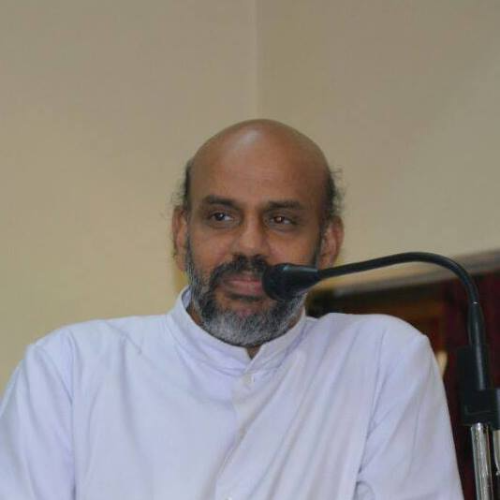
To Listen to Him... Bishop Arulselvam Rayappan
The Parables on Perseverance in Prayer
We all know that our first Christian duty is to pray, and the best form of prayer is through the Eucharistic Celebration in which we participate today.
This year, Luke's Gospel is in a special way called "The Gospel of Prayer." Jesus is portrayed as praying more often in this Gospel than in the others. At important moments, He prays: for instance, before beginning His ministry, before choosing the disciples, on the Mount of Transfiguration, and during His moments of intense agony. Jesus was praying to the extent that the disciples, after seeing Him, requested, "Lord, teach us also to pray," and then the beautiful prayer, Our Father, was taught by Jesus.
A few weeks ago, we heard about the parable of a friend at midnight going and knocking at the door of his friend because he had an unexpected guest for whom he had nothing to offer. Jesus taught us that we have to pray with perseverance.
Last week, it was about the parable of the Widow and the Unjust Judge. The judge was not afraid of God, and he did not respect men. But this woman kept asking him. He said, "She's torturing me, putting me into difficulty; she is a nuisance." Jesus said, so the judge did all that she wanted. If that is the case with the unjust judge, how much more will God grant your prayer?
The Parable on Humility in Prayer
Today, we have heard another Parable on prayer. Jesus says it's not enough to pray with perseverance; you must also pray with humility.
We heard a Pharisee praying. In those short two verses, five times he says, "I, I, I." The Pharisee thought that God must be grateful to him. "Lord, I thank you," he said, but then, "for what? I'm not like that fellow; I'm not like the sinners; I'm not like the extortioners; especially, I'm not like the fellow standing over there, the tax collector." The true prayer is to thank the Lord for all that the Lord has given to you. Do not compare yourself with people, thinking that you are more righteous.
Today's Gospel began like this: "Some of them are thinking that they are the most perfect, and all others are wicked." Jesus said, "Do not think like that." You know, in John, Chapter 8, we read about the woman caught in adultery. All of them were ready to find fault with Jesus, asking Him, "What do you say?" They wanted to trap Jesus. If He says, "You can stone her to death because she was caught in adultery," they will say, "Jesus is without mercy, no compassion." If He says, "Leave her free," they will say, "Jesus is tolerating all kinds of wickedness." But then Jesus answered, "The one who has no sin, let him be the first to cast the first stone at her." Jesus proved to them that they are more wicked than that woman caught in adultery.
Here also, this man (the Pharisee) is comparing himself with others. My dear brothers and sisters, sometimes it happens: "Oh, that man is doing this, this man is doing that; I am much better." Our point of comparison is Jesus our Lord Himself. If Jesus were in your place, would He do it? Do not say, "Very good," to yourself because you are better than some of the people. We need to follow the Gospel. Do I follow the Gospel? Let us not worry about others; let's worry about ourselves only. "I do this, I do this, I do this." The Lord says at the end, the Pharisee's prayer was not heard.
But the other person, the Tax Collector, he says, "Lord, have mercy on me, I am a sinner." Today, that should be our prayer, my prayer, all of our prayer, my dear brothers and sisters: "Lord, have mercy on me."
The Necessity of Humility
Elsewhere we heard Saint Paul saying, "What is it you have that you have not received? And if everything you have is what you have received, why do you boast?" There is nothing to boast. We are all receiving grace upon grace only from God. If you study well, it is because of God's grace; God has given you intelligence. If you are enjoying good health, it is because of God's abundant favors. If you have a decent job, it is because of God. We need to be grateful; we need to be humble.
Most of the quarrels come in the family—why? Because we are not humble. What is humility? I always say my own definition: Humility is the recognition that we need God and we need others.
Above all, we need God. What is the use of accumulating money? Suddenly, you become sick, which is incurable. You need God. Don't forget God. What is the use of being arrogant? We need our brothers and sisters, our parents, our grandparents.
Humility is the recognition that we need God, we need others. There are some who don't talk to their own brothers and sisters, some who don't even say "Good morning," "Good evening"—a greeting. What does it cost you? Why can't you smile a little more and greet people? Don't think that other people are part of the landscape. Take the initiative to talk to people, to greet them at least. That is true humility. We need others, we need our relationship. Only then will all other things fall into place. Renew your relationship with God, with others. That's very, very important.
Humility—every time we come to the church, that's what we have to learn. We look at the Tabernacle, the Lord is present for us so simply. We look at the Cross. Saint Paul says in his letter to the Philippians, though He was in the form of God (that famous hymn), how He humbled Himself, even up to death on the cross. That is the lesson. If at all the Lord wants us to learn something from Him, it's not to do wonders, but He said, "Learn from me, for I am meek and humble of heart."
How do you manifest your humility? By respecting others, realizing that everything we have is from God, and then always constantly manifesting our reliance on God.
God Shows No Partiality
Today's First Reading from the Book of Sirach says, "The Lord shows no partiality." You also should not show any partiality, especially the poorest of the poor, the weakest of the weakest—you have to treat with respect.
They always say the greatness of a person lies in how that person deals with people who cannot do him any good or any wrong, any harm. Suppose somebody will beat you back, give you in return, you are very respectful to them. But somebody who cannot do anything against you, you show your might to them—like some men showing their might with their wife and children, but with their boss, they are very, very respectful. To the wife and children, they are arrogant, treating them as though they are lifeless objects. Your greatness, my dear brothers and sisters, lies in how you deal with people who cannot harm you, who cannot do you any good. Remember this: The Lord takes note of it.
And then, today's First Reading also tells us, The Lord hears the prayer of the humble. The Lord hears the prayer of those who are poor and abandoned. There is no prayer that is not heard, especially the silent tears of the innocent—the Lord watches. Be aware, don't be the cause of anyone's tears. You have to give an account. Your husband should be happy because of you; your parents should be happy because of you; your children should be happy because of you. You should not be the cause of their tears.
Every Prayer is Heard
The Lord will hear the prayers of each and every one. Sometimes we say, "Father, we are going on praying; nothing seems to be happening." No, my dear brothers and sisters, there is no prayer that is not heard by the Lord; every prayer is heard.
Take for example, in the Garden of Gethsemane, Jesus was praying, "Father, take this cup away from me." He was praying. The Father was "praying" to Jesus: "Drink this cup, Son." Son was praying to the Father; Father is "praying" to the Son: "Drink this cup." But then, the Father did not leave Jesus alone. According to Luke's Gospel, God the loving Father sent angels to strengthen Jesus to accept the Cross. Beautiful! God will remove some of our sufferings. Even if the suffering doesn't go away, the Lord will give us the necessary strength to bear our suffering boldly.
So, continue to pray with perseverance, with humility. Be always grateful to the Lord. Don't say, "My prayer is not heard." Every prayer is heard, maybe not according to the way you expect, but according to the best way God wants for us.
Finishing the Race
And in today's Second Reading, a beautiful passage, Saint Paul is writing to his disciple Timothy from the prison. Saint Paul says, "Come on, Timothy, follow my example. I have fought the good fight, I have finished the race, I have kept the faith. I have kept my faith till the end."
Some of our brothers of different Christian denominations say, "I am saved, I am saved." Nobody is saved already, here and now. You were saved, you are being saved, you will be saved. You need God till the very end to keep your faith. Don't say, "I am saved," and do what you want. You were saved, you are being saved today, and you need God to save you till the end, till you reach the grave. Saint Paul says, "I have kept the faith so far; imitate me. Some people deserted me, but the Lord did not let me down. I was saved from the lion's mouth," meaning I was saved from so many people who wanted to simply swallow me.
And then, finally, today's Second Reading is: "To God be glory and honor forever and ever." Only to God. Not like that Pharisee who prayed, "I accomplished, I did this, I did this," as if God is indebted to him. He is not indebted to God, not at all, my dear brothers and sisters.
As you go out of this place today, the Lord is inviting you to trust Him more and to continue in your pilgrimage of faith. Be a blessing to all the people, to respect others, learn from Him humility, depend on Him all the time. May our participation in this Eucharistic Celebration transform our lives, that we may be a joy to God, and a joy to one another.
Amen.